
The Tulare Directory Shelf
The strongest starting point is the exact local inventory. The Hillman room holds a changing geographic mix: some titles are countywide, some cover Tulare and Visalia, and later Tulare City volumes include nearby communities. This table keeps the verified year runs together so a city directory search does not assume an annual book.
| Collection | Verified years or items | Where held | Access |
|---|---|---|---|
| Tulare County Business | 1888, two copies | Hillman Genealogy Room | Onsite or volunteer inquiry |
| Tulare County Business/Resident | 1904-05 | Hillman Genealogy Room | Onsite |
| Multi-county telephone | 1908-09 | Hillman Genealogy Room | Includes Tulare and five neighboring counties |
| Tulare Telephone | 1921 | Hillman Genealogy Room | Onsite |
| Tulare City | 1925 | Hillman Genealogy Room | Onsite |
| Tulare City & Tulare County | 1932-33 | Hillman Genealogy Room | Onsite |
| Polk's Tulare County | 1934 through 1956-58, with gaps | Hillman Genealogy Room | Onsite |
| Polk's Tulare-Visalia | 1955 | Hillman Genealogy Room | Onsite |
| Polk's Tulare City | 1961 through 1993, with gaps | Hillman Genealogy Room | Later titles include Pixley, Tipton, and Woodville |
The library inventory's 1993 entry is the latest item documented in the 2018 holdings list, not proof of a final publication date. Ask for the exact edition before relying on its coverage.
Early Tulare Directory Titles
Before the Polk run, the local city directory shelf is a mix of business, resident, and telephone sources. The 1888 Tulare County Business books are the earliest verified items. The 1904-05 Business/Resident title adds a different kind of name clue. A multi-county telephone book from 1908-09 includes Tulare and five neighboring counties, followed by Tulare Telephone in 1921 and Tulare City in 1925.
These titles do not answer the same question. A business directory may favor firms and public roles. A telephone directory may include a listed subscriber and omit an unlisted one. A resident title may have its own address or classification rules. Note the title, publisher, year, and geographic label each time a city directory entry is copied.
The Tulare Public Library genealogy page is the current route for holdings, room service, and volunteer help.
Polk's Tulare Directory Years Have Gaps
Polk's Tulare County titles are held for 1934, 1936, 1937, 1939, 1941, 1942-43, 1944, 1947-48, 1950, 1952, 1953-54, and 1956-58. Polk's Tulare-Visalia appears for 1955. Polk's Tulare City is held for 1961, 1963, 1965, 1967-69, 1972-77, 1979-82, 1985-86, 1989, 1991, and 1993.
A gap can mean that a year was not printed, that the local copy was not retained, that a volume moved, or that the household was omitted from that edition. Search the nearest earlier and later years rather than filling the missing year with an assumption. A name that leaves one title may reappear in a countywide book or newspaper.
The California State Library's research guide also points readers to City Directory and Telephone Book databases. It is a statewide fallback when the Hillman shelf lacks the target year, but its indexing and images should be checked against the local volume record.
Why Tulare Directory Books Include Nearby Towns
Directory geography changes across the shelf. Countywide titles can reach beyond the City of Tulare. The 1955 Polk's Tulare-Visalia title has a different scope from a Tulare City title. The research specifically notes that 1961 and later city volumes include Pixley, Tipton, and Woodville. A family may therefore appear in a Tulare-area city directory while living outside the incorporated city.
Record the publication's geographic label beside each address. Do not use a book's word “Tulare” as a substitute for the city boundary, postal city, or county jurisdiction. When a directory clue needs a modern parcel match, move to the address and APN workflow on the Tulare streets page.
Hillman Room, Tulare Directory Desk
The Hillman Family Library of Local History and Genealogy sits at the far south end of 475 N. M Street. Genealogy-room hours are Tuesday through Friday, 1 to 5 p.m., and no appointment is needed. The direct line is 559-685-4518; the main library number is 559-685-4500. Email at info@tularepubliclibrary.org can route a question to volunteers.
The collection holds more than 7,000 genealogy volumes, a California Collection, the checkoutable Hyde II Collection, Tulare Advance-Register microfilm, Visalia Daily Delta and Morning Delta microfilm for 1892-1928, limited Porterville Evening Recorder obituaries, county certificate and cemetery indexes, census material, surname files, subject files, city and phone directories, Ancestry access, and microfilm or microfiche readers.
Sequoia Genealogical Society supports the room by purchasing materials, staffing volunteers, conducting research, and answering phone or email questions. That human bridge matters when a city directory is not digitized or a surname is hard to read.
Reading One Tulare Directory Entry
A printed entry must be read from the actual edition. The research did not capture a scanned Tulare Polk resident entry, so no field can be promised for every local volume. Look for the name, exact spelling, address, occupation, spouse or family notation, owner status or other classification, and a reverse section only when the page and abbreviation key show those features. Copy the printed form instead of silently expanding an abbreviation.
- Title, publisher, and year establish the edition.
- Alphabetical name placement helps find a person or business.
- Address or street entry can connect a name to a place for that year.
- Occupation or relationship shorthand may help separate same-name entries when printed.
- Abbreviation key and reverse section rules control how the line should be read.
- Criss-cross directory
- A reverse or street-organized section used to move from an address back to a printed name.
- Householder index
- A name-based list of household heads or listed residents, if a given volume uses that structure.
- Abbreviation key
- The edition's own legend for occupation, relationship, address, or classification shorthand.
Absence from a line is weak evidence. A person may be unlisted, may appear under a spouse or business, or may fall outside the volume's geography.
Five Tulare Directory-Era Sanborn Editions
Sanborn fire-insurance maps are not a city directory, but they are a strong companion for address history. The Library of Congress collection documents Tulare sheets from 1885, 1887, 1892, 1906, and 1913. The maps help identify building footprint, use, construction clues, and changes to a block. They do not name every resident.
Use a map after locating a directory address. Compare the street shape, lot pattern, building outline, and nearby landmark with the printed entry. The result can distinguish a changed number from a changed building, or a rebuilt site from a household move. Keep the map year beside the directory year.
The California State Archives is the official state archival route for catalog and reference questions, while the local Sanborn sheets are available through the Library of Congress collections.
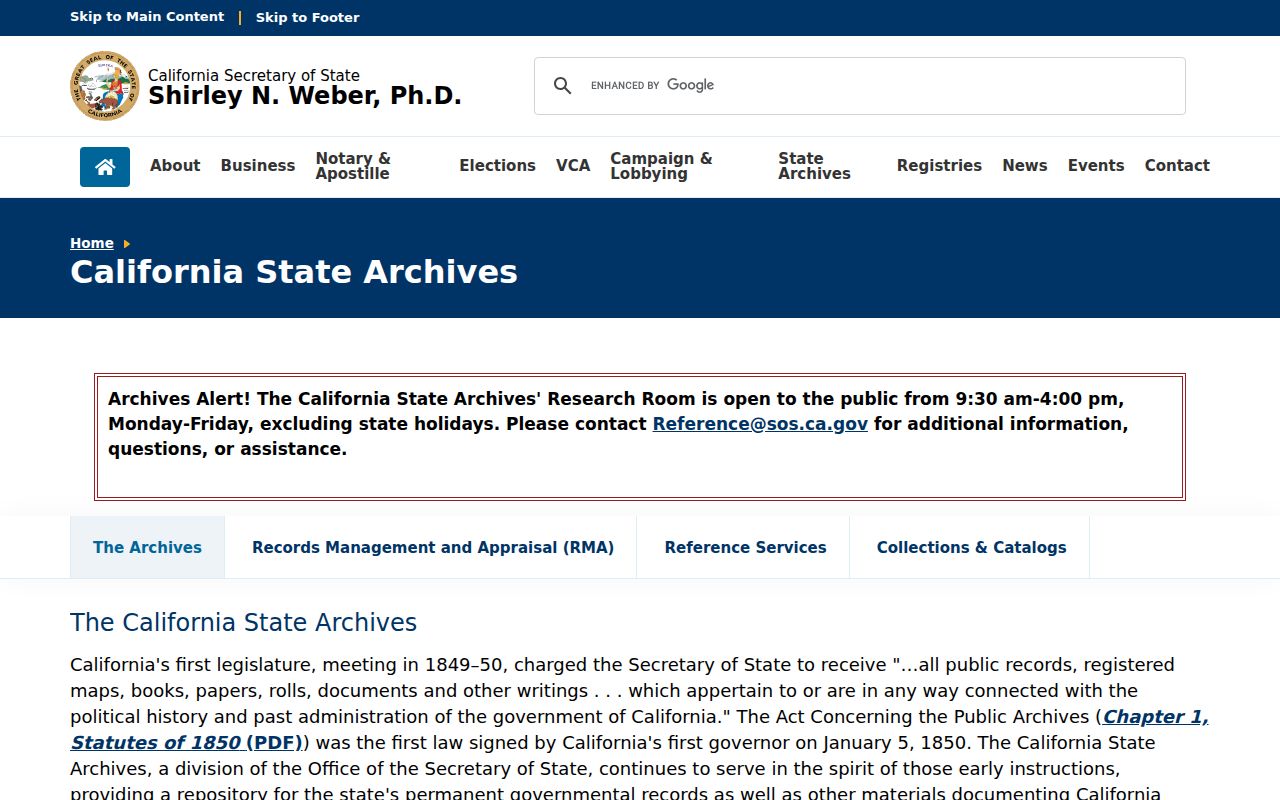
The archive route is useful when a local directory clue points toward county or state records that never reached a modern web index.
Tulare Newspaper Clues for Directories
Newspapers can bridge a missing city directory year. Hillman holds Tulare Advance-Register microfilm and Visalia Daily Delta or Morning Delta film for 1892-1928. Limited Porterville Evening Recorder obituaries add another county source. Notices can connect a name to a relative, club, address, occupation, move, death, or probate event, but each statement still needs its source date and page.
Chronicling America catalogs Tulare's weekly Alliance Messenger from the 1880s. Surname files and subject vertical files at Hillman can point to deposited material, yet a file created by a prior researcher is a lead, not official proof. Ask a volunteer which newspaper run or index covers the target year before assuming that a blank search means no notice exists.
Trace Tulare Families Through Directories
Tracing a household works best as a dated chain. Choose a known address or year, then bracket it with the nearest held volumes. A city directory can fill the years between federal census releases, while the census supplies relationships, ages, and birthplaces that a directory usually does not. As of 2026, 1950 is the latest public decennial census under the 72-year rule.
- Write the person's full printed name, variants, address, and the exact title and year.
- Check the next earlier and later held volumes rather than assuming annual continuity.
- Read the edition's abbreviation key and use its reverse section only if present.
- Pair 1940 and 1950 directory clues with the public federal census, then compare household relationships.
- Use newspapers, cemetery indexes, an obituary, probate, deed evidence, or a vital record to test the ending.
A name that disappears may reflect a move, death, omission, an unlisted entry, a changed geography, or a missing volume. A dated directory line is moderate historical occupancy evidence when another source agrees. It is not a current residence guarantee.
Tulare's Library Hall Directory Story
Southern Pacific built Library Hall in 1882 at today's 88 W. Tulare Avenue for employee recreation. Railroad-donated books sat behind locked glass, and service cost 50 cents per person each month. Southern Pacific transferred the hall to the City in 1896. The City describes the building, now the Woman's Club, as Tulare's oldest surviving building.
That story is a useful reminder that a place can change purpose while its address remains a research anchor. A directory, deed, newspaper, map, and institutional history may all describe the same location from different angles. Keep those angles distinct when reconstructing a Tulare household or building.