
Finding Tulare Residents by Record
A useful Tulare residents directory search moves from a broad clue. That clue leads toward a record that can be checked. A name alone is weak. The same surname may appear in city, county, and neighboring-community records. An address is a stronger starting point. But an assessor parcel identifies land and an owner, not every person connected with the property. The best trail notes the source, date, role, and jurisdiction at each step.
Start with the least assumptive source. A county property search can turn a street address into an APN. The Recorder can show a deed party and a legal description. Court and business indexes add roles rather than residence claims. The library fills older gaps. A record may exist without a public search screen. In that case, a narrow records request is the fallback.
- Write down the full name, spelling variants, known date range, and any Tulare address or business clue.
- Search the Tulare County Assessor by street address, landmark, or APN to establish a parcel pivot.
- Use the Tulare County Recorded Documents index by name, document number, or document type.
- Check the California My Voter Status form only for an individualized verification, never as a street list.
- For an older household, ask the Hillman room for the exact directory year, then use a city or county records request for a remaining gap.
A single matching name is only a starting point. Stronger evidence comes from a dated address, a legal description, a case role, or a credential identifier, and two independent matches beat one every time.
Where Tulare Resident Records Live
Tulare is a city inside Tulare County, and the county seat is Visalia. That geography shapes every residents directory search. City Hall holds city-created permits, agendas, contracts, code material, and police records. The County Assessor/Clerk-Recorder keeps parcel and deed systems. The same office holds vital certificates, fictitious business names, and other durable indexes. The Superior Court holds the county trial-court index, while the library preserves older printed evidence.
Tulare County Recorder
221 S. Mooney Blvd., Room 103
Visalia, CA 93291
559-636-5050
Tulare County Assessor
Property Information Search
Assessor GIS Maps and parcel data
Confirm current line on office page
The county counters and the court sit mainly in Visalia, so an in-person Tulare search should be routed by record creator. A city address does not make every record a City of Tulare record.
Tulare's Name-to-Parcel Trail
The County Assessor is the cleanest bridge from an address to land. Its public description advertises searches by address, landmark, or APN. An APN is simply the assessor's parcel identifier. Save the APN, situs address, map context, and any legal description. Do this before moving to the Recorder. The public landing page does not verify an owner-name search. So a name should not be presented as a supported assessor search mode.
| Assessor search mode | What to enter | Use in a resident trail |
|---|---|---|
| Street Address | Known physical address | Find the parcel tied to the location |
| Assessor's Parcel Number | APN or assessment identifier | Keep the land reference steady across records |
| Landmark | Named place or map clue | Locate a parcel when a full address is missing |
The parcel opens the next door. A Tulare County deed can tie a grantor and grantee to a legal description at the Recorder. Even so, it never lists every occupant of the property. That limit keeps a Tulare residents directory search honest. The search stays anchored to what each record truly says.
Tulare Recorder Evidence Levels
The Recorder's index is a locator, much like a library card catalog. The county suggests trying spelling variants. It confirms name, document number, and document type as search modes. Once the matching instrument is selected, an online application and purchase prompt can provide a copy. The counter accepts an application and payment. The mail route uses the Recorded Document Request Form. The recorder also advertises public computers and microfiche. Hours run Monday through Friday, 8 a.m. to 5 p.m.
| Level | What it gives | Best use |
|---|---|---|
| Free index | Party, document number, type, and recording sequence | Locate the instrument |
| Purchased image or copy | Deed terms, legal description, parties, and date | Check the land and transfer |
| Certified copy | Copy with the Recorder's certification process | Use when formal proof is required |
Copy fees come straight from the posted schedule. The Recorder charges $3 for the first page and $1 for each additional page. Certification adds $2 more for each extra copy. Those figures apply to the county's recording-copy process alone. They do not cover city, court, or state requests. Remember that an online index entry and a document image are never the same level of evidence. An index entry only points you to the record itself. The image is what carries the weight.
Current Tulare Resident Sources
Modern records each act as a partial directory. None covers every Tulare household. Read each source for what it can show and what it cannot, and the residents directory workflow stays reliable.
| Source | Possible clue | Keeper | Boundary |
|---|---|---|---|
| Assessment information | APN, situs, assessed data, parcel map | County Assessor | Ownership and land, not every occupant |
| Recorded deed index | Grantor, grantee, document type and date | Recorder | Parties to instruments, not a household roll |
| My Voter Status | Individual status, party preference, precinct route | California Secretary of State | Identity verification, not public street browsing |
| Court case index | Party name, case role, event or disposition where public | Tulare Superior Court | Restricted and sealed records are omitted |
| Business and license records | Entity, credential, status, or public filing address | California agencies | Business affiliation is not residence proof |
Chasing one person calls for a name-and-record comparison in the Tulare resident lookup workflow. A full named street is a different job. For that, use the address-focused Tulare streets search instead of stretching a partial roll past its purpose.
The Tulare Voter Lookup Is Individual
California My Voter Status verifies one voter at a time. It requests a first name, last name, and date of birth. When required, it also asks for a driver license or identification number. Alternatively, it accepts the last four digits of a Social Security number. Returns may include registration status, party preference, county, and precinct or election details. They may also show polling place or vote-center information, and ballot status as applicable. It is a self-check tool. It is not a browsable Tulare residents directory.
Access limits are strict. Elections Code section 2194 restricts the voter file to election, scholarly, journalistic, political, or governmental purposes. It bars commercial use entirely. Government Code section 7924.000 shields home street addresses, phone numbers, emails, precinct and registration identifiers, prior registration data, credential numbers, and signatures. That protection applies outside the statutory voter-file system. Safe at Home enrollees get added protection from disclosure.
Privacy boundary. A no-match on My Voter Status does not prove that a person never lived in Tulare. Registration changes, protected records, spelling, and maintenance actions can all affect a result.
Voter roll copies in this county flow through the Registrar of Voters. The office sits at 5951 S. Mooney Blvd. in Visalia. It holds the county's voter rolls. It also handles the application route for anyone seeking file access. Fees, delivery media, and the current application form change often enough. A caller should confirm each detail with the office before making a trip or mailing a request.
Tulare Court Names Need Context
Court indexes answer a different question than a residents directory. The Superior Court of California, County of Tulare offers an online case-information search. It also provides courthouse counters and a formal records-request path. A public result can carry a case number and party names. It may list the case category, hearing dates, and a status or disposition. The docket is simply the court's running event history. A charge or petition is not a finding of anything.
For a cross-check inside a Tulare residents directory entry, use the case number. Pair it with the party role and the final disposition. Probate files can support lawful heir research. Petitions, notices, inventories, and personal-representative details all name people tied to an estate. Sealed, juvenile, adoption, dependency, and confidential family-law material generally stays out of public view. Older or archived files may need a clerk request or a counter visit.
Federal cases do not live in the Tulare trial-court index. They run through PACER and the Eastern District of California. A court record confirms a role and an event, nothing more. It should never be stretched to force a same-name person into a residence claim.
Tulare Vital Record Copies
Birth, death, marriage, and divorce certificates come through two channels. The Tulare County Clerk-Recorder handles local records. The California Department of Public Health covers the statewide route. California applies no single genealogy opening-age rule to modern records. Health and Safety Code sections 103526 and 103526.5 apply. They split certified copies into two types: authorized and informational. An informational copy carries a mark noting it cannot establish identity.
The CDPH request form asks for plenty. Record type, event place, and date go on the form. Names go on it too, and so do parents' birth names when relevant. The applicant's relationship, purpose, and signature follow. So do a sworn statement or notary block for an authorized mailed copy. State and county fees differ. CDPH lists birth copies at $31, death at $26, marriage at $19, and divorce certificates at $18. The county birth fee appears as $34.
The California Vital Records ordering page lays out the current route. A certificate proves an event or a family link. It is not a public list of current Tulare residents.
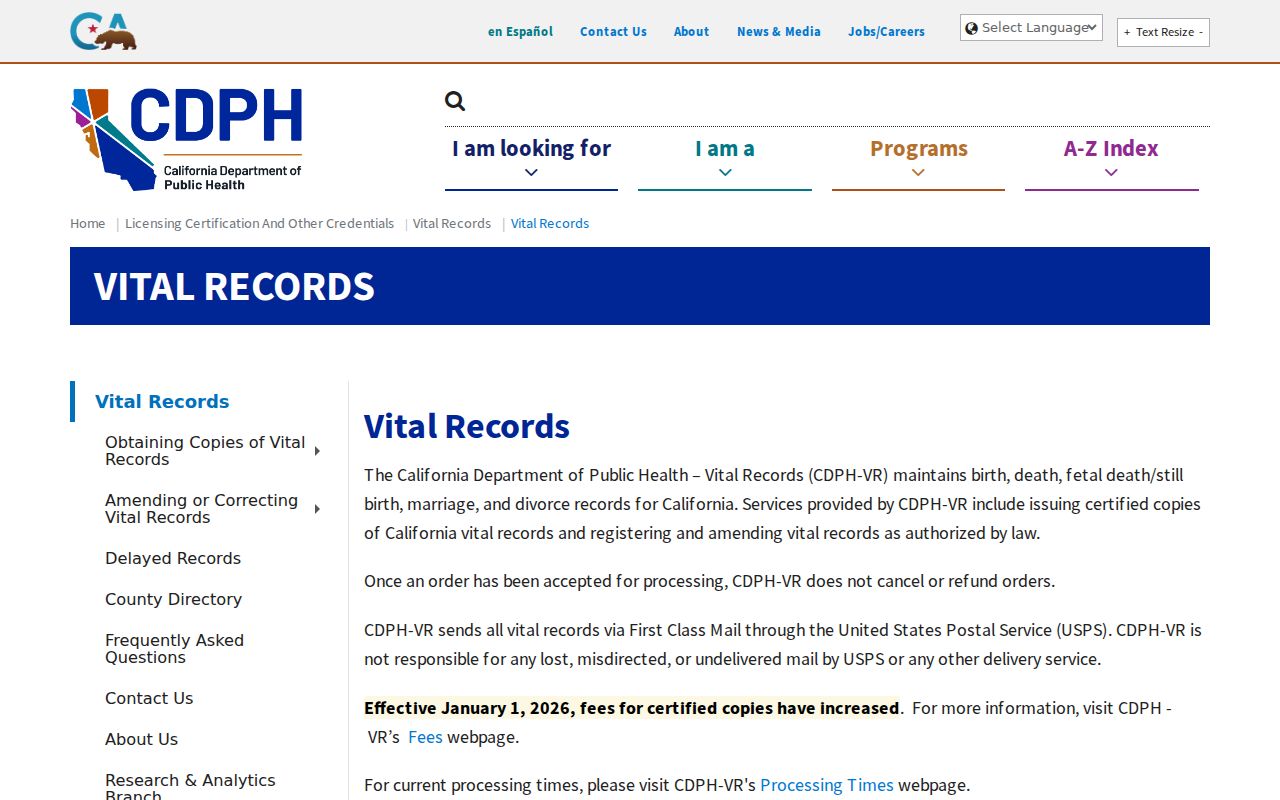
The state ordering screen draws a clear line between an official copy request and an open name search. Eligibility rules and the current form control what a requester can obtain.
Hillman Room, Tulare Directories
The Hillman Family Library of Local History and Genealogy anchors offline Tulare residents directory research. You will find it at the far south end of 475 N. M Street. Genealogy-room hours run Tuesday through Friday, 1 to 5 p.m., with no appointment needed. Call 559-685-4518 direct, or 559-685-4500 for the main library line. Email research requests can be routed to volunteers at info@tularepubliclibrary.org.
The holdings run deep. More than 7,000 genealogy volumes sit alongside the California and Hyde II collections. The microfilm includes the Tulare Advance-Register. It also holds the Visalia Daily Delta and Morning Delta from 1892 through 1928. Certificate and cemetery material fills out the room. Census records, surname and subject files, city and phone directories, Ancestry access, and microfilm or microfiche readers are there too. Sequoia Genealogical Society volunteers can bridge a missing year or an unindexed surname.
Exact directory runs live on the Tulare city directory collections page. A step-by-step household trail is there too. The home-trail takeaway is simpler. When a current portal dead-ends, this library is a real fallback.
Tulare Business and License Clues
Business and professional records can corroborate a name, a role, or a date in a Tulare residents directory search. They cannot turn a work address into a home address. California bizfile lets you search by entity name or file number. Optional filters cover type, status, and initial filing date. A result may show the entity number, status, jurisdiction, agent for service, filing dates, and filed documents. SOS filings say nothing about ownership, telephone, email, or where a person lives.
Professional licenses open a second door. The California DCA License Search takes a board or bureau, license type, license number, business name, first and last name, or registry number. Advanced filters narrow by city and county, primary or secondary status, disciplinary actions, and public documents. A license result can show the credential, its status, issue and expiration dates, and legally publishable address details. Contractors, real-estate agents, attorneys, educators, and alcohol-license holders often sit in separate systems.
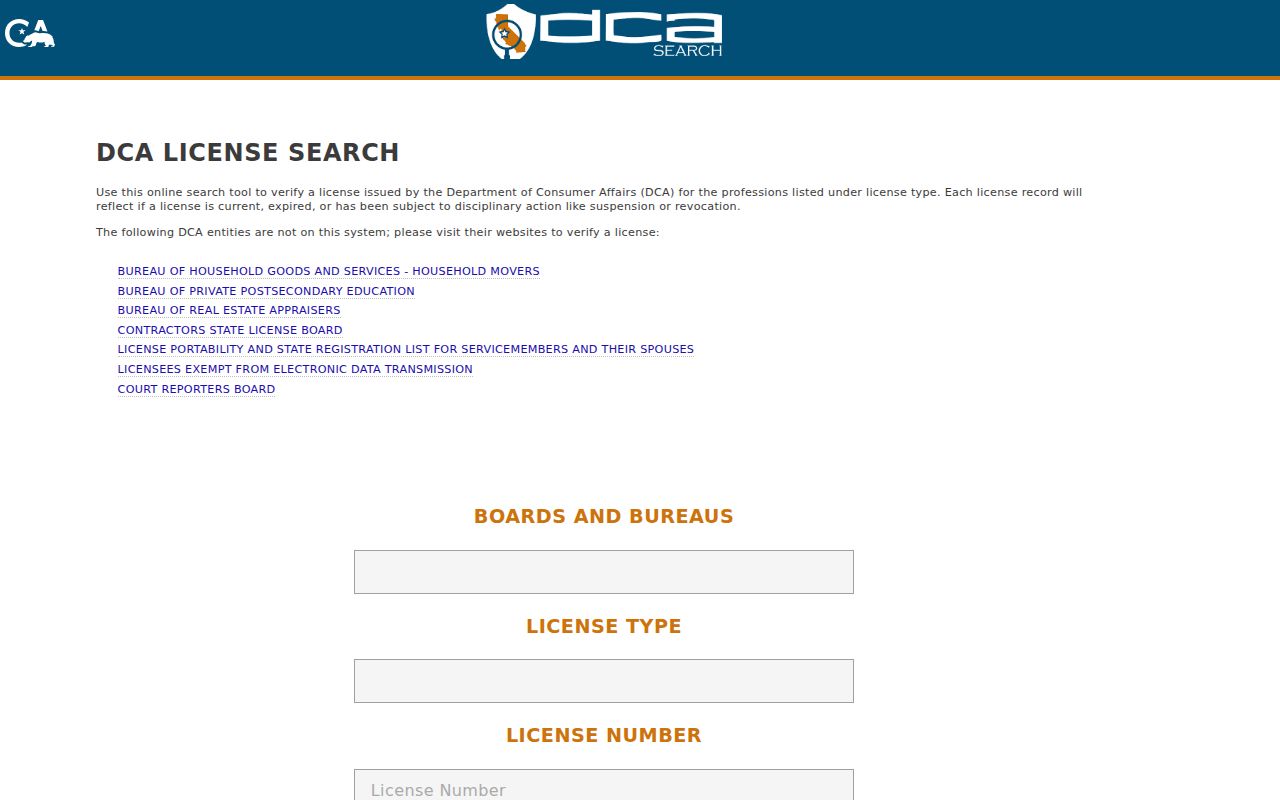
Work from the identifier and status date on a live result. A professional connection is one corroborating point, never a residence conclusion for a Tulare residents directory.
Tulare Unclaimed Property Leads
The State Controller's unclaimed-property search takes just an owner name and location. A hit can surface an older reported address or a family relationship. That helps a genealogy or reconnecting search. The claim itself demands identity or relationship evidence. The Controller is clear that an owner may claim directly without paying a finder.
Treat unclaimed property as a lead, not a Tulare residents directory entry. Cross-check the name against the reported location. Also weigh any business connection, dates, and parcel or newspaper records. A reported location is not a current address. A missing result is not proof a person lacks a Tulare connection either. The California Unclaimed Property search shows the official name-and-location route.
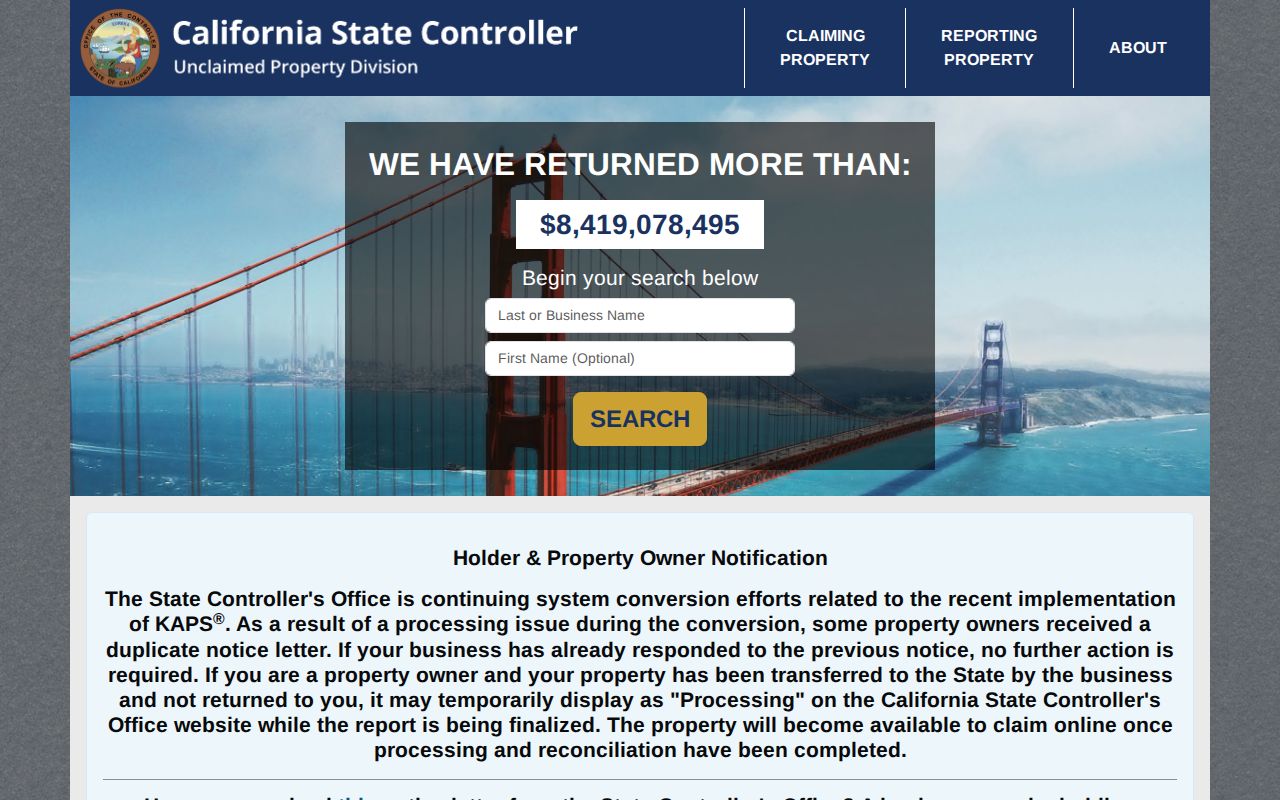
Treat the results screen as a lead for a follow-up question, not as proof someone lived in Tulare.
Tulare Records Requests by Creator
When a public record is not posted, ask the office that created or keeps it. Tulare City requests can be made through the City Clerk's online form, by email or other accepted channel, or through an inspection appointment. The form asks for the records and date range, a contact name, email and phone, a delivery choice, and an optional file upload up to 5 MB. Electronic records and inspection are free. Ordinary paper copies are $0.10 per black-and-white page or $0.25 per color page, and a CD is listed at $6.
Requests need not be written, but a clear description with subject, date range, title, author, street number, street name, case type, or permit clue makes the search workable. The CPRA determination period is ordinarily ten days, with a possible written extension of no more than fourteen additional days under Government Code section 7922.535. That period is not a promise that production is complete.
City police records can include arrest logs, calls for service, statistics, crime reports, and accident reports, subject to exemptions. The City's Police public-records guidance explains those categories and the ten-day determination rule. Building plans may need extra authorization. For county material, use the Tulare County CPRA request route. Ask for an identifiable existing record, not an open-ended dossier about a named person.
Tulare's Historical Directory Shelf
The Hillman shelf is a timeline of Tulare names. It opens with an 1888 Tulare County Business directory, followed by a 1904-05 Business/Resident volume, a 1908-09 multi-county telephone directory, a 1921 Tulare Telephone book, and a 1925 Tulare City title. Later holdings cover 1932-33 Tulare City and Tulare County. Polk's Tulare County volumes run from 1934 through 1956-58 with gaps. Polk's Tulare-Visalia appeared in 1955. Polk's Tulare City titles stretch from 1961 through 1993, also with gaps.
Each edition prints only the fields it prints. An entry can place a name, address, occupation, spouse notation, or business at a dated point, but only if that particular volume carries the field. No scanned Tulare entry or universal abbreviation key exists. Judge each volume by its own terms. Sanborn sheets from 1885, 1887, 1892, 1906, and 1913 hold the building and street context steady while the directories supply the people. Later Polk titles include Pixley, Tipton, and Woodville, so the geographic label on a directory matters. A full collection table, the library route, and a household-tracing method round out the city directory section.
Tulare's Railroad Library Story
Southern Pacific built Library Hall in 1882. It stood at today's 88 W. Tulare Avenue and served as recreation space for employees. Railroad-donated books sat behind locked glass. Service cost 50 cents per person each month. The company handed the hall over in 1896. The City now calls the building, home of the Woman's Club, Tulare's oldest surviving structure.
That story frames any historical search. A deed, directory, map, newspaper, or institutional file can point to the same address for different reasons. A place that began as a railroad library can surface later in civic and family-history sources, so pair the record type with the question it can actually answer.
Tulare Safety Records Have Limits
California's Megan's Law website offers authorized public registry information through name and geographic modes. A registry result is a narrow public-safety record, not proof of a current household, and its own use restrictions apply. Likewise, the CDCR Incarcerated Person Locator covers state-prison custody, not a complete criminal history. A jail booking is not a conviction.
The official California Megan's Law search is the proper route for the information it publishes. For a court question, use the Tulare Superior Court index and preserve the case disposition. Do not use any record to watch, threaten, or repeatedly contact a person.
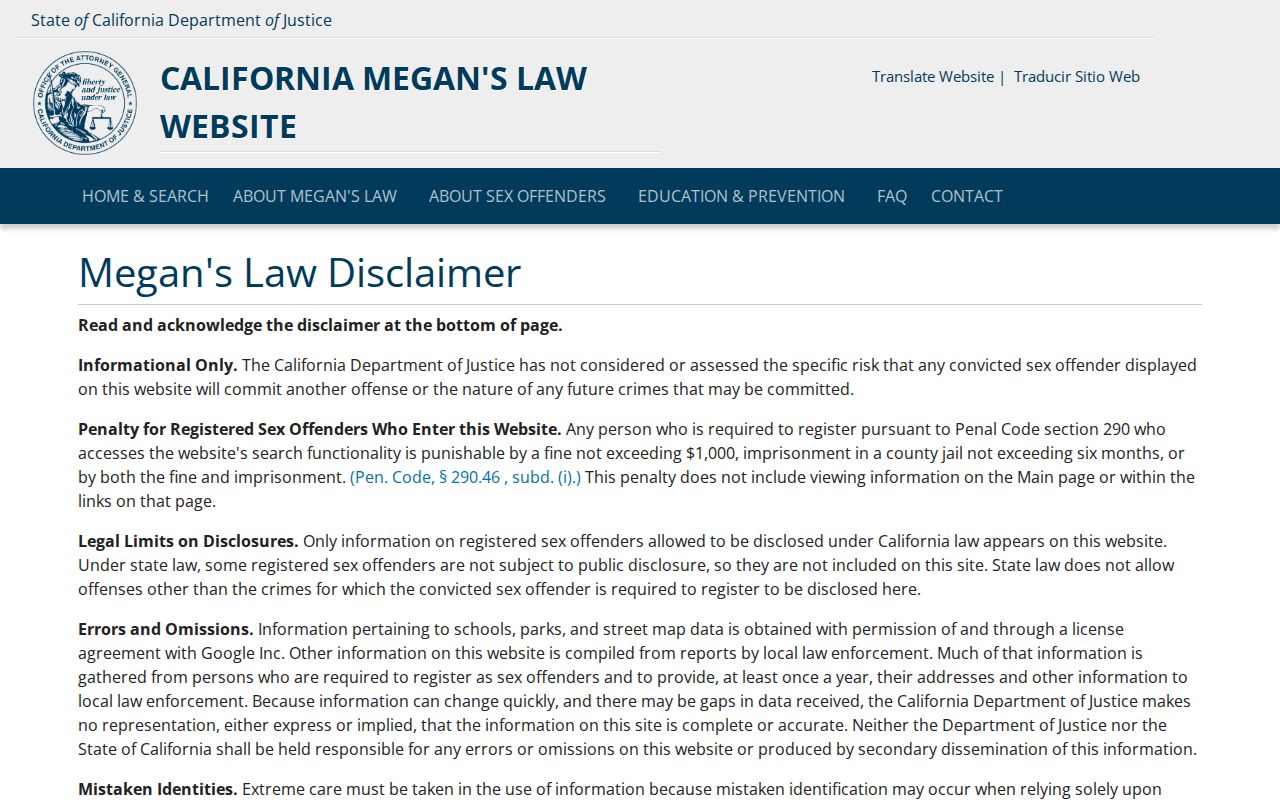
A registry screen makes clear why any public result must stay inside its stated purpose and scope.
Responsible Tulare Directory Use
These records serve everyday purposes. They support family history, heir work, reconnecting with a classmate, checking a business affiliation, understanding a neighborhood, and civic research. They grant no permission to republish private details. Nor can a parcel map become a household roster. A missing record may reflect a protected person, a sealed file, a changed spelling, a cutoff, or a collection that has not been digitized.
Use the narrowest useful source. Keep the record identifier and date, verify a meaningful claim with the custodian, and stop when the lawful public trail ends. Public availability does not excuse stalking, harassment, intimidation, or harm.
Use the Tulare by-street workflow for address chains. A named person fits the resident lookup. For older households, start with the exact Hillman volume rather than assuming a continuous annual series.